Open source · Qiskit 2 · OpenQASM 3v0.18.3 · What's new
Learn and build quantum computing in your browser
A free learning platform and web IDE in one: lessons with quizzes in Khmer and English, a Playground, a drag-and-drop composer, simulators, a debugger, and real IBM and IQM hardware. For school kids, students, teachers and researchers.
Free · account in a minute or guest mode · Khmer and English
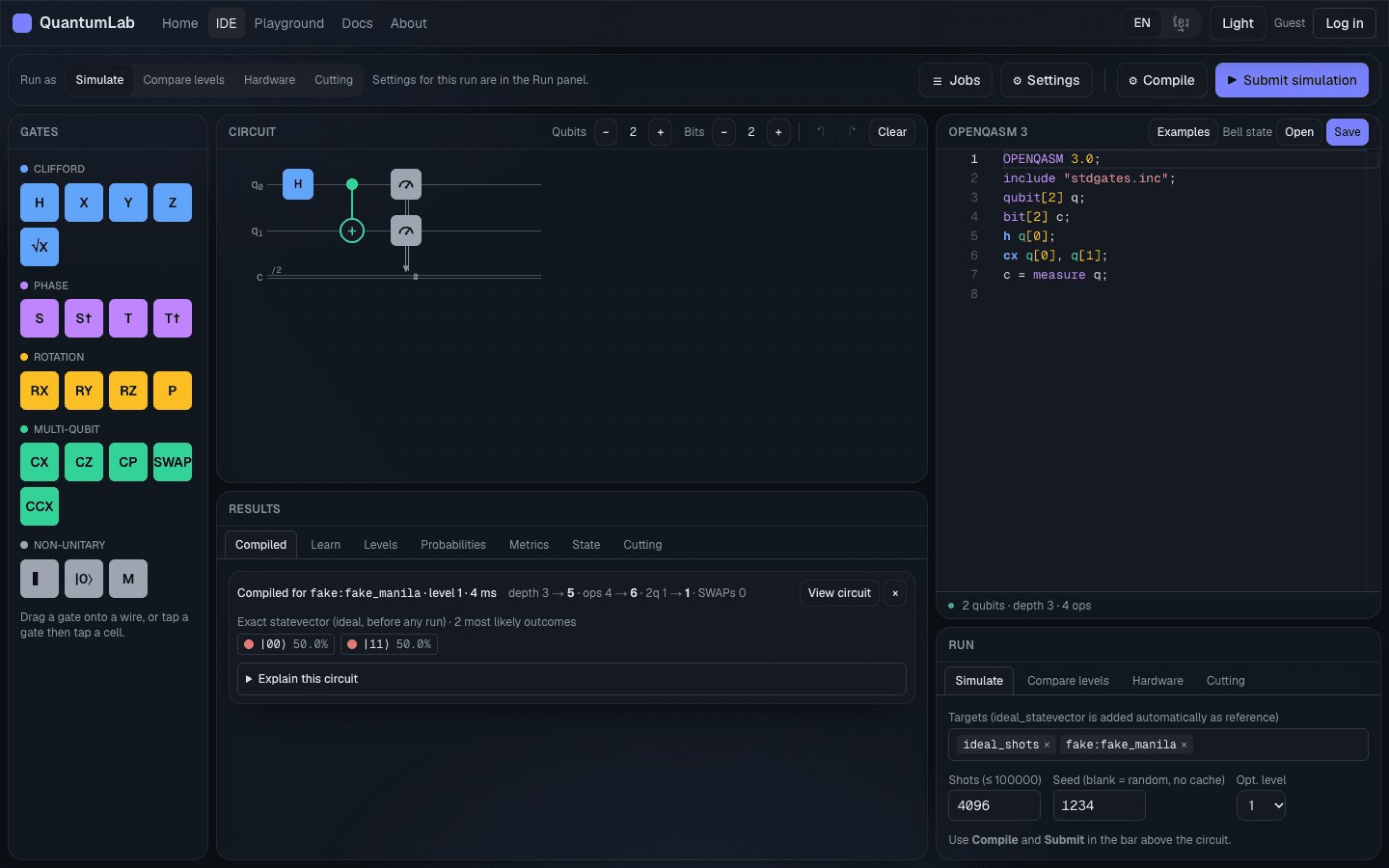
qubitlab · ide1 · Drag gates onto the wires; the code writes itself
Simulate Compile Submit
Circuit
OpenQASM 3
1OPENQASM 3.0;
2include "stdgates.inc";
3qubit[2] q;
4bit[2] c;
Results
Press Compile after the last gate…
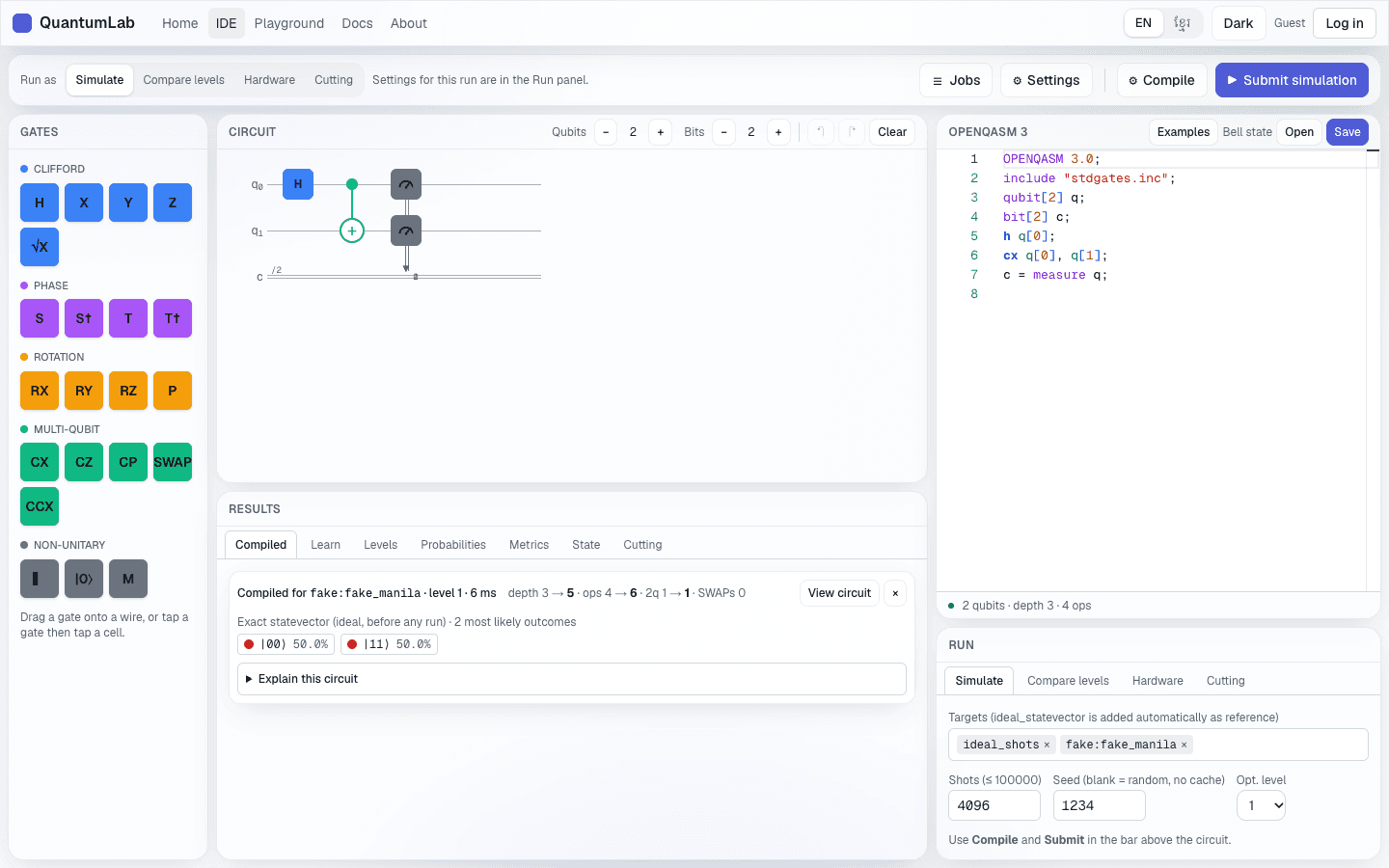
See a real screenshot of the IDE
Our visionSolo AI engineer · quantum researcher
If you can draw a line and a box, you can start quantum computing.
We imagine a Cambodia where every school kid, student, teacher and researcher can touch a real quantum computer in their own language, free of charge: learn from the first qubit to the first algorithm, run on real IBM and IQM machines, and grow the country's first generation of quantum researchers. What we build for Cambodia is open to the whole world.
- 30gates in the palette
- 36MQT Bench algorithm families
- 68noisy IBM fake backends
- 40lessons in 7 learning tracks
- 2hardware providers: IBM and IQM
- 2languages: English and Khmer
How it works
- 1
Build
Draw a circuit or paste OpenQASM 3. Validation runs as you type.
- 2
Compile
Pick a target and press Compile to see the transpiled circuit, the exact statevector and the math, before spending any compute.
- 3
Submit
Submit to simulators, a fake backend or real hardware, watch live status, and compare results side by side.
Learn, then prove it on a real machine
Step-by-step lessons written for QubitLab, heat maps of real chips, and real hardware with your own token.
LearnSeven tracks and 40 lessons from qubits to QAOA, with quizzes, ranks and circuits that open in the IDE.Quantum machine learningHands-on exercises: qubit rotation, parameter-shift gradients, encodings, a variational classifier, kernels, VQE.Chips as heat mapsEvery fake backend drawn like IBM's device pages: T1, T2, readout and two-qubit errors on the real layout.
Verified on a real IBM Heron r2A Bell circuit submitted from the IDE to ibm_kingston (156 qubits) on a free account: |00⟩ 52.7 %, |11⟩ 46.1 %, Hellinger fidelity 0.987, back in 8 minutes.See the machines and live calibration →
Try an example circuit
Six favourites from 2 to 4 qubits. Click a card to open it in the IDE, press Compile to see the state, then Submit to run it.
What you can do
Composer + code, in sync
Drag gates onto wires or type OpenQASM 3 in a VS Code-style editor. Both views update each other instantly, with parse errors marked on the exact line.
Compile and compare
Transpile at optimization levels 0–3 for a generic basis or any of 68 IBM fake backends. Compare depth, two-qubit gates and SWAPs, and inspect the mapped circuit.
Simulate with metrics
Run on ideal statevector, Aer sampling, MPS, density matrix and noisy fake backends. Get TVD, Hellinger fidelity and success probability against the exact reference.
See the state
Q-sphere with phase colouring, Bloch spheres with purity, per-branch states for dynamic circuits, and a step slider that replays the circuit layer by layer.
Real hardware: IBM and IQM
Bring your own IBM Quantum or IQM Resonance token. It is validated, encrypted at rest and never shown again. Runs are guarded to the machine's own size, 4096 shots and depth 300.
Learn circuit cutting
How large circuits are cut into subcircuits and their expectation values rebuilt, explained step by step in the docs and the Cutting and Quantum ML lessons.
About us and what we provide
A free, open-source quantum lab from Cambodia, in Khmer and English.
Open for access, free of charge
Start now with your own guest account. No fee, no card.
What we provide
Lessons, IDE, Playground, simulators and real hardware in one place.
From Cambodia, for everyone
Built solo for learners studying in Khmer and English.
Safe by design
Python runs in a locked sandbox. Tokens stay encrypted.
Built with you
Your feedback shapes the roadmap. Open source (MIT).
Help shape QubitLab
Found a bug or want a feature? Tell us, and we reply in your Dashboard.
Have a personal account? Follow the status under Dashboard → Feedback · see what changed in the changelog.